The Julie Mango: The Smooth, Cultured Royalty of Jamaican Terroir

Updated: 15 hours ago

If you read our viral deep dive into the legendary, fibrous East Indian mango, you already know what makes Jamaica's premium mango belt so special. But no exploration of Caribbean horticulture is complete without looking at the other side of the coin.
Welcome to the ultimate guide to the Julie Mango (Mangifera indica 'Julie')—the smooth, custard-like queen of the West Indies. While the East Indian wins on sheer size and wild intensity, the Julie commands premium market prices through its sophisticated, fiberless texture and complex tropical flavor profile. Let us break down the exact botanical background, specific coastal terroir, and expert growing solutions that make this dwarf cultivar an absolute masterpiece.
For a deeper look at Jamaica's mango heritage explore our Complete Guide to Growing East Indian mangoes In Jamaica:The Complete Guide to Growing East Indian Mangoes in Jamaica
If the East Indian mango is the bold, untamed, and fibrous king of the Jamaican roadside, the Julie Mango (botanically classified as Mangifera indica 'Julie') is the sophisticated, buttery queen. Often called the Saint Julian, this iconic cultivar flipped the mango world on its head by delivering an ultra-smooth texture entirely free of strings.
For bloggers, growers, and backyard connoisseurs alike, understanding the Julie mango means looking past its compact frame and exploring the microclimates, coastal pressures, and complex soil dynamics that make it the second most prized—and second most expensive—mango in Jamaica.
1. Botanical Background & Pedigree
Scientific Taxonomy: Class Magnoliopsida, Family Anacardiaceae (the cashew, pistachio, and poison ivy family), Genus Mangifera, Species Mangifera indica.
The Evolutionary Split: Unlike the East Indian mango, which is highly polyembryonic (producing clones true-to-seed from a single fruit), the Julie is monoembryonic. This means its seed contains a single embryo derived from cross-pollination.
Historical Pathway: Its genetic markers point to an elite Indian lineage. Seeds were carried across the globe to the French island of Réunion before finding a perfect home in Jamaica and Trinidad in the 1700s and 1800s. Because it is monoembryonic, true premium Julie mangoes must be propagated via grafting rather than planted from seed to protect their distinct varietal purity.
My teeth are ready, but my mind isn't Checking out the flesh and tasting two of the most popular mango varieties on earth- Julie and east Indian. One has the ultimate velvety mouthfeel, while the other packs a massive flavor punch. Let's see which one is actually worth the hype.
2. Fruit & Flavor Profile: Sensory Analysis
While the East Indian boasts an intense, wild, resinous punch, the Julie is a master class in flavor balance.
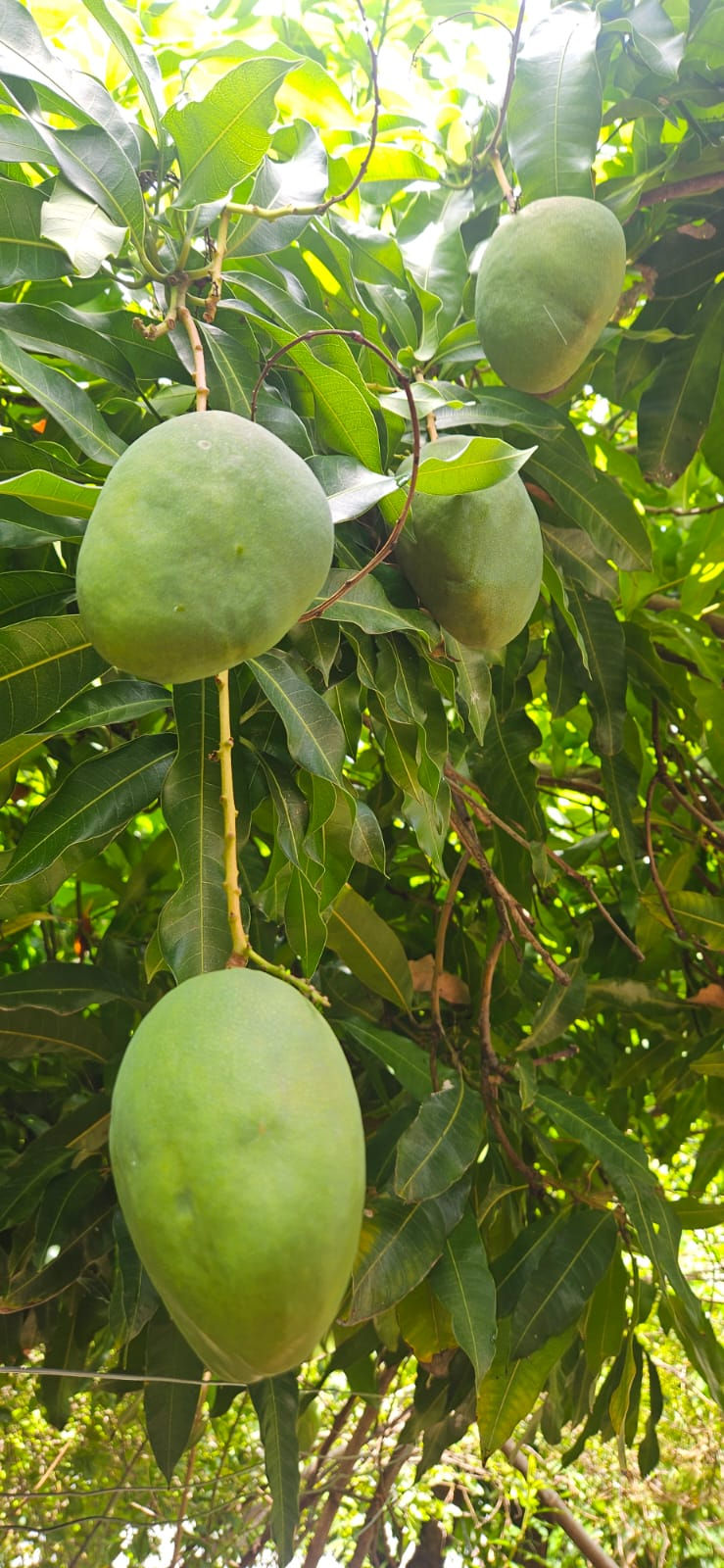
Physical Architecture: Small to medium, distinctly oval, flat-ish, and asymmetrical. It features a unique, gentle curve or "shoulder bump" on one side.
Color Transitions: The skin remains predominantly deep green or greenish-yellow at maturity, but it develops a striking, sunset-like red-orange or pinkish blush on the top shoulder directly exposed to the sun.
The Texture Revolution: Slice into it, and you will find brilliant golden-orange flesh. It is completely fiberless. It possesses a firm, melting, custard-like consistency that peels away cleanly from its thin, flat seed.
The Tasting Notes: It combines high natural sugars with complex top-notes of creamy coconut, bright pineapple, and a subtle hint of warm, aromatic sweet spice.
3. The St. Thomas Terroir & The Premium Mango Belt
Just like its rival, the Julie mango achieves legendary status when grown in the
St. Thomas Premium Mango Belt. While the tree can survive in wetter, western parishes like Westmoreland or Portland, those regions cause the fruit to become waterlogged and bland. St. Thomas offers the ultimate terroir for three structural reasons:
High Solar Radiation (The Brix Accelerator)
St. Thomas enjoys an intense, unobstructed daily sun path. This intense sunlight supercharges the tree’s photosynthetic rate. It forces an elite accumulation of natural sugars within the fruit, driving up its internal Brix levels (sweetness metrics).
The Alluvial Fan Advantage
The parish's soils are largely shaped by alluvial deposits washed down from the Blue Mountains. These well-draining, gravelly, and sandy loams prevent water from pooling around the roots. Julie roots are notoriously sensitive to soggy soils, making this drainage profile essential.
Micro-Climate Dry Spells
The rain-shadow effect of the mountain ranges shields southeastern St. Thomas from constant downpours. This specific dry stress mimics the native environments of ancient Indian cultivars, signaling the tree to stop growing leaves and focus all its energy on blooming flowers.
4. Coastal Sea Spray & Soil Salinity
Growing a Julie mango right along the coastlines of St. Thomas or coastal St. Catherine brings specific challenges. The Julie possesses a moderate tolerance to coastal elements, but managing the environment requires precise strategies:
The Sea Spray Deficit: The thick, waxy cuticle layer on Julie mango leaves offers strong physical protection against airborne salt spray carried by sea breezes. This makes it an exceptional shade tree for coastal properties.
The Salinity Threat: In the soil, it is a different story. Excessively high salt levels (30 mm or higher) trigger osmotic stress. This restricts the root system's ability to pull up fresh water, resulting in leaf-tip burning, yellowing (chlorosis), and stunted growth.
The Solution: If you are planting in sandy, brackish coastal soils, you must flush the root zone with deep, fresh water during periods of high evaporation to push salt buildup downward past the root zone. Incorporating regular applications of agricultural gypsum (calcium sulfate) and heavy organic compost helps displace harmful sodium molecules and improves soil structure.
5. Intense Dry Spell & Drought Management
The Julie mango tree is incredibly drought-hardy once fully established, but it requires active intervention during Jamaica’s intensifying seasonal dry spells.
The Dual-Phase Water Strategy: To achieve a massive harvest, you must manipulate your watering schedule based on the tree's reproductive cycle:
1. The Stress Phase (Pre-Bloom): Intentionally withhold irrigation for 2 to 3 months during the dry season. This environmental stress forces the vegetative buds to go dormant and triggers heavy flower panicle development.
2. The Development Phase (Fruit-Set): Once the flowers bloom and tiny green mangoes form, switch to deep, infrequent watering. If the tree experiences a total drought during fruit development, it will drop its fruit early to save itself.
Mulching Protection: Maintain a thick 4-to-6-inch layer of organic mulch (such as woodchips or dried grass) around the root canopy drip line. Keep the mulch a few inches clear of the actual trunk to prevent rot. This locks in essential sub-surface moisture and drops root-zone temperatures during scorching heatwaves.
Parish-Specific Challenges & Solutions
Depending on where your readers live in Jamaica, a Julie tree will face distinct regional roadblocks:
Anthracnose & Powdery Mildew (High-Humidity Parishes)
In wet, humid areas like Portland, St. Mary, or Hanover, the fungal pathogens Colletotrichum gloeosporioides (Anthracnose) thrive. It attacks flower clusters, causes young fruit to rot on the branch, and leaves black spots on the skin.
The Solution: Lean into the Julie’s natural asset: its dwarf growth habit.
Prune the center of the canopy immediately after harvest to open up the tree into an open-bowl shape.
This maximizes internal airflow and sunlight penetration, drying out wet leaves before fungal spores can take hold.
Apply organic neem oil or copper-based fungicides safely before flower buds pop open.
The West Indian Fruit Fly (Dry, Fruit-Heavy Parishes)
In southern, sun-drenched parishes like Clarendon and St. Elizabeth, the West Indian Fruit Fly (Anastrepha obliqua) targets ripening Julie mangoes. Because the Julie is fiberless and soft, female flies easily pierce the skin to lay eggs, turning the sweet flesh into a soft, maggot-ridden mess.
The Solution:
Hang pheromone or molasses-based bait traps throughout the canopy to capture adult flies before they breed.
Practice strict orchard hygiene by raking up and safely destroying all fallen or damaged fruit every day so larvae cannot escape into the soil to pupate.

7. The Ultimate Tropical Growing Guide for the Julie Mango
Growth Phase | Core Action Plan | Technical Target |
Site Selection | Full, unobstructed tropical sun. | 8 to 10 hours of daily direct sunlight. |
Soil Requirements | Slightly acidic to neutral loam. | Target pH range between 5.5 and 7.5. |
Planting Geometry | Dig a wide hole; mix in aged compost. | Hole size 1m x 1m; ensure the graft union stays clear of soil. |
Young Tree Care | Deep watering every 2 to 3 days in dry spells. | Apply high-nitrogen organic fertilizers to build branches. |
Mature Tree Care | Switch fertilizer blends as the tree ages. | Shift to High-Potassium/Phosphorus blends to boost fruiting. |
Canopy Trimming | Annual pruning directly after the final harvest. | Maintain a tight, compact dome shape below 10 to 12 feet. |
8. The Deep-Dive Reader Q&A
Q: Why do my Julie mango flowers keep drying up and dropping off without making fruit?
A: This is usually driven by either a late-season rainy spell or a heavy infestation of Powdery Mildew fungus. If it rains constantly while the tree is blooming, the water washes away the pollen and keeps local bees from doing their job. Opening up your tree's canopy with regular pruning improves airflow and helps keep those delicate flower clusters dry.
Q: Can I grow a Julie mango tree if I only have a small concrete yard or a balcony?
A: Yes! The Julie mango is widely loved because it is a genetically dwarf cultivar. It adapts beautifully to life in a large, heavy-duty 15-to-30-gallon container. Just make sure the pot has excellent drainage holes at the bottom, use a premium coarse potting soil mix, and place it in the absolute sunniest spot on your property.
Q: Why does the Julie mango command such a high price in Jamaican markets compared to common varieties?
A: Its premium price comes down to its behavior on the tree and its elite status. Because it is a dwarf tree, it naturally yields a smaller total volume of fruit per tree than a massive, 40-foot common mango tree. Combined with its high vulnerability to tropical moisture fungi and intense local demand for its signature fiberless texture, the limited supply drives market prices up significantly.
Conclusion
Planting a Julie mango tree isn’t just about harvesting fruit—it’s about nurturing community, savoring sweetness, and bringing a taste of pure paradise into your yard With its rich, creamy texture and unforgettable aroma, the Julie remains the undisputed queen of Caribbean mangoes.
The East Indian brought the bold flavor, but the Julie brings the smooth finish. Keep asking, keep planting, and keep tasting—your mango journey is only getting sweeter.
Until next time, keep your hands in the soil, your heart light, and let joy grow.
With love from Hopey’s Garden.


Comments